Fluid Futures Melting Lands at the Hyams Museum
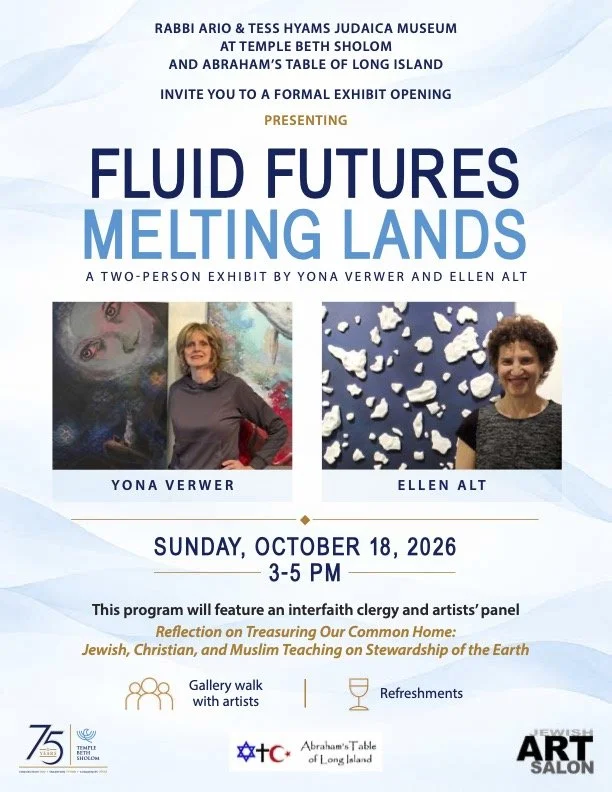
The Hyams Museum at Temple Beth Sholom, with the Jewish Art Salon and Abraham’s Table of Long Isand, presents Fluid Futures / Melting Lands, a two-person exhibition by Yona Verwer and Ellen Alt exploring ocean pollution and melting glaciers.
Opening Sunday, October 18, 2026, 3–5 p.m.
Rabbi Ario S. and Tess Hyams Judaica Museum
Temple Beth Sholom, 401 Roslyn Road, Roslyn Heights, NY
The opening on Sunday, October 18, 3–5 p.m., includes an interfaith clergy and artists’ panel, Reflection on Treasuring Our Common Home: Jewish, Christian, and Muslim Teachings on Stewardship of the Earth; a gallery walk with the artists; and refreshments. - Register
Verwer’s Fluid Futures series depicts marine life entangled in, or navigating through, plastic debris. Raised near the North Sea in the Netherlands, she draws on repairing the world and the seas.
Alt’s ten-part White Series treats glaciers as vaults of planetary memory, asking what is lost as ice recedes and what land, history, and possibility emerge.
The opening on Sunday, October 18, 3–5 p.m., includes an interfaith clergy and artists’ panel, Reflection on Treasuring Our Common Home: Jewish, Christian, and Muslim Teachings on Stewardship of the Earth; a gallery walk with the artists; and refreshments.
Registration here
Both artists’ practice is deeply rooted in Jewish environmental ethics. The Torah instructs humanity "to till and tend" the Earth (Genesis 2:15), while the principle of Bal Tashchit ("do not destroy"), originating in Deuteronomy and expanded by the rabbis of the Talmud, prohibits wastefulness and needless destruction.
Once the planet's living waters, the oceans have become a stark symbol of humanity's environmental impact. Plastic pollution has reached even the Mariana Trench, while microplastics are now found in marine life, drinking water, and the human body.
Growing up near the North Sea in the Netherlands, a country shaped by rivers, canals, and coastlines, much of it below sea level, Verwer developed a profound relationship with water that continues to inform this work.
At the same time, melting glaciers are transforming the Earth's landscape. As sea levels rise and threaten coastal communities, land long buried beneath ice is being revealed.
Through mixed-media works, Alt explores the shifting balance between water and land, imagining what may emerge as the ice recedes. The glaciers are envisioned as vaults of planetary memory, preserving Earth's history within their frozen depths. As they melt, they release those memories, offering both a record of the past and a reminder of humanity's enduring capacity for connection and communication.
Healing the world's waters and ice is not optional; it is essential to healing the planet itself. As Pirkei Avot 2:16 teaches: "You are not obligated to complete the work, but neither are you free to desist from it."
Verwer’s Fluid Futures series depicts marine life entangled in, or navigating through, plastic debris, reflecting both the fragility of ocean ecosystems and the urgent responsibility to protect them. In Jewish tradition, Tikkun Olam ("repairing the world") and the related concept of Tikkun HaYam ("repairing the seas") call upon humanity to become active partners in restoring creation.
Alt’s The White Series, is a ten-part narrative, exploring the delicate equilibrium between ice and water, salt and fresh, liquid and frozen. It asks what is lost as glaciers disappear and what new landscapes, histories, and possibilities are revealed in their absence.
Embedded throughout the series is the same call to Tikkun Olam: the responsibility to restore balance, sustain life, and protect the interconnected ecosystems upon which all species depend.